


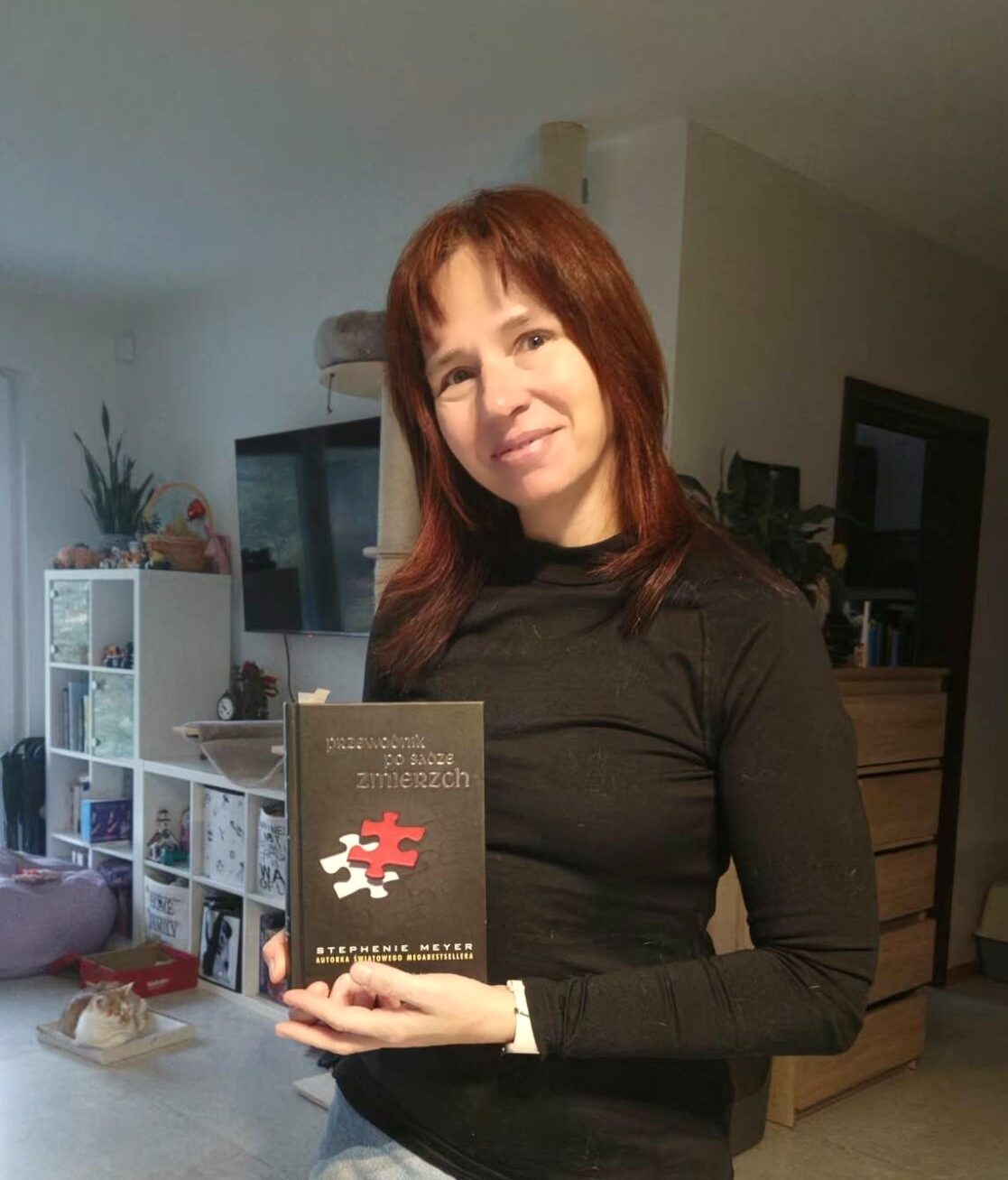
When I hear “Robert Pattinson”, I see Edward Cullen, and I suspect I’m not alone. I have a professional excuse, though. When I was translating the Polish edition of The Twilight Saga: The Official Illustrated Guide, I had to catch up fast. I read every book in the saga, watched the film and worked through the spin-off, The Short Second Life of Bree Tanner.
Well over a decade later, the association hasn’t faded. Pattinson seems well aware of it, because he has worked hard to shed that image and grow as an actor. He has already been Batman, and soon we’ll see him as 007. Yet in every role, the little vampire fangs still show.
Is that good or bad?
Translators like to say that specialisation will save us from the AI purge. There’s some truth in it: if you work in a niche served by a handful of people with specific training, you can position yourself as a rare and valuable professional.
Literary translation, the circle closer to my heart, isn’t uniform either. Some of us specialise in children’s books, non-fiction, fantasy, role-playing games or comics. So if we commit to a single genre, do we become the Robert Pattinsons of translation?
The good news is that literary translation plays by slightly different rules than commercial translation. It demands sensitivity and, above all, the ability to speak in many voices, often within a single book. That is a challenge, but also a real asset. Every new book tests how flexible a translator’s mind can be.
That’s how I approach new projects. I worked on the Twilight guide some time ago, but I still think back to it fondly, because it was an unusual job. It isn’t a novel, though it deals entirely with fiction. It’s more like a chronicle of the Twilight universe, with precise references to specific moments in the plot, a carefully mapped timeline and explanations of how the characters are connected.
Translator’s masks – how we hide away the little vampire fangs
Since then, I’ve translated children’s books, comics and graphic novels, memoirs and diaries, as well as crime fiction and thrillers for adult readers. Clearly, I’m hard to pigeonhole, and happy about it. A translator has one advantage over Pattinson: nobody sees our face. A crime reader doesn’t need to know that the same person once translated a book for six-year-olds. They should hear the author, not me. The fangs stay filed away in my desk.
That doesn’t mean I walk away from projects empty-handed. The Twilight guide taught me to check every reference and keep track of the timeline, which comes in handy in a crime novel where readers count the minutes between the murder and the alibi. Children’s books taught me the rhythm of a sentence read aloud. Comics taught me to fit emotion into a speech bubble of fixed size. Memoirs and diaries made me tread carefully with words that belong to a real person, not a character. Every genre hands me a tool I use in the next one.
So when someone asks about my specialisation, my answer is literary translation, and within it, changing my voice to whatever the text demands. If a new book requires me to get to know an entire fictional world at speed, I know how it’s done. I once read a whole vampire saga in the line of duty.